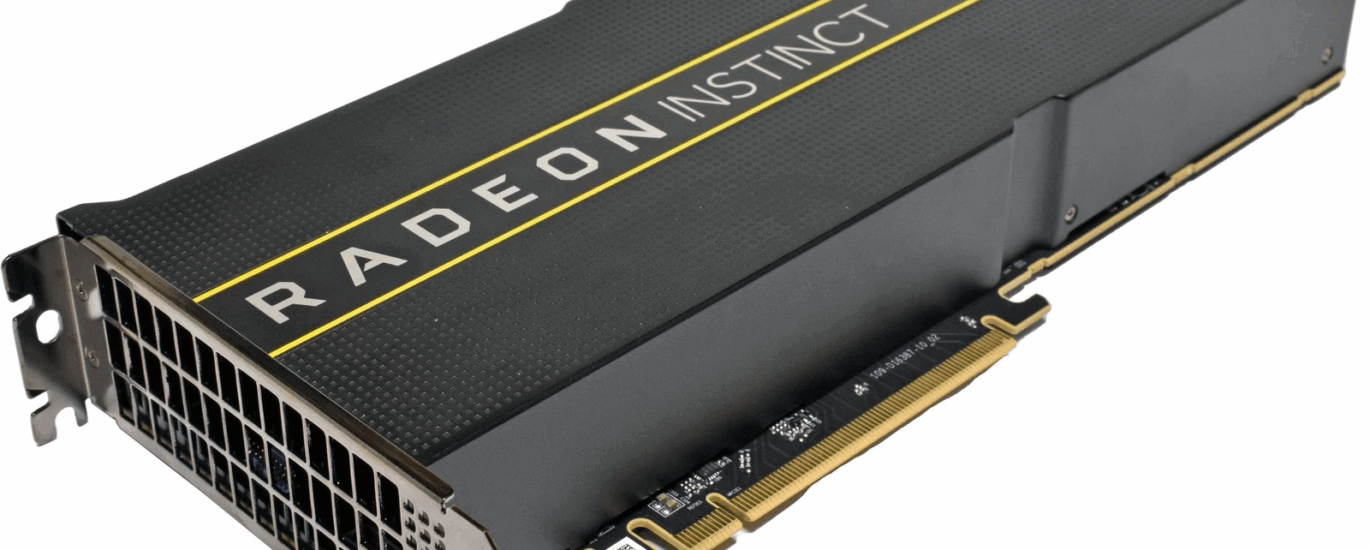
In the fast-paced world of artificial intelligence, where headlines tout trillion-parameter models and hyperscale data centers, one truth often gets overlooked: you don’t need the latest hardware to build groundbreaking solutions. As of September 2025, the AI hardware market is dominated by exorbitantly priced Nvidia H100s and AMD’s own MI300X accelerators, with entry costs soaring into the tens of thousands. Yet, for developers, startups, and enterprises diving into machine learning (ML) and large language models (LLMs), yesterday’s hardware can power today’s innovations—at a fraction of the price. Enter the AMD Instinct MI50: a 2018-era accelerator that’s still a powerhouse, delivering 16GB of high-bandwidth HBM2 memory for $250–$280 as new old stock (NOS). At LocalArch AI Solutions, we’ve leveraged the MI50 extensively for TensorFlow model building and LLM deployment, and the verdict is clear—it’s not just viable; it’s a strategic cornerstone for cost-conscious AI builders.
Remark: all $ here means US dollar.
We’re on a mission to democratize on-premise AI through reliable, affordable hardware. Our inventory includes pristine NOS AMD Instinct MI50 cards, sourced directly from original stock, alongside custom workstations powered by the AMD EPYC 7352 processor (24 cores/48 threads) with NOS motherboards. These aren’t used or refurbished; they’re brand-new components from original production runs, ready for modern AI workloads. This article unpacks why the MI50 remains a top choice in 2025, from its technical merits to real-world benchmarks, and how pairing it with EPYC-based systems unlocks applications that deliver exceptional return on investment (ROI) without the vendor lock-in or power bills of newer rigs.
The MI50’s Enduring Specs: VRAM King on a Budget
Built on AMD’s Vega 20 architecture, the Instinct MI50 was designed for datacenter compute, boasting 16GB of HBM2 memory—a capacity matching pricier modern cards like Nvidia’s A40 or entry-level H100 variants. With 13.3 TFLOPS of FP32 performance and PCIe 4.0 for blazing-fast data transfer, it’s a robust choice for inference and fine-tuning tasks. What sets it apart in 2025? Unbeatable value. While a new Nvidia RTX 5090 retails for $1,999+ (often scalped to $3,000), our NOS MI50s, never used and sourced from original batches, are priced at $250–$280. This affordability stems from their status as surplus stock from 2018 production, offering enterprise-grade performance at consumer-level costs.
This VRAM parity is critical for LLMs, where memory bottlenecks can derail progress. Models like Llama 3 (70B parameters) or Mistral variants demand substantial headroom for quantization and batch processing. The MI50’s HBM2 delivers bandwidth up to 1 TB/s, enabling smooth handling of these without the sharding headaches of lower-VRAM consumer cards. AMD’s ROCm platform keeps it relevant: as of ROCm 6.0 and beyond, the MI50 is in “maintenance mode” but retains full compatibility for TensorFlow and PyTorch. Our team has run official TensorFlow Docker images on MI50s without issues, accelerating convolutional neural networks (CNNs) for image recognition by 5–7x over CPU baselines.
Benchmarks from early 2025 highlight its staying power. In Ollama tests with dual MI50 setups (totaling 32GB VRAM), users reported inference speeds of 15–25 tokens/second for 70B models at Q4 quantization—modest compared to an H100’s 100+ tokens/sec, but more than adequate for prototyping, edge deployment, or internal RAG (retrieval-augmented generation) pipelines. A September 2025 forum post praised a £200 NOS MI50 setup running full 70B LLMs on a consumer PC, calling it a “budget miracle” for small teams. It’s not about raw speed; it’s about accessibility. For use cases where blazing throughput is overkill—like fine-tuning domain-specific chatbots or training lightweight transformers—the MI50 excels.
Real-World Wins: TensorFlow Builds to LLM Deployment
Our extensive experience with the MI50 spans dozens of projects, from computer vision in TensorFlow to LLM orchestration via tools like vLLM on ROCm. For a recent financial client, we built a sentiment analysis pipeline using BERT variants: the MI50 handled distributed training across four NOS cards, processing terabytes of textual data with 90% GPU utilization. Setup was straightforward—ROCm 5.7 on Ubuntu, paired with TensorFlow’s AMD plugin—and results were compelling: models converged 20% faster than on equivalent Intel Xeon setups, thanks to the EPYC synergy we’ll explore later.
For LLMs, the MI50 thrives in multi-card configurations. Its PCIe design enables seamless scaling in a single chassis, pooling VRAM for models that would otherwise require cloud rentals. We’ve deployed Llama.cpp on ROCm with MI50 clusters, achieving 2–4x efficiency gains over CPU-only runs for inference-heavy apps like virtual assistants. A January 2025 blog post echoed this: “Running LLama.cpp on ROCm with NOS AMD Instinct MI50 is a steal,” even as AMD prioritizes newer architectures. Drawbacks? It’s Linux-centric (Windows via WSL2 is clunky), and FP8/FP4 support trails newer Instincts. But for 80% of ML workflows—prototyping, validation, and low-volume serving—these are minor trade-offs against an $800 price point.
Compare the alternatives: Nvidia’s ecosystem is mature, but an A100 with comparable VRAM costs $8,000+ used, locking you into CUDA and subscription creep. Intel’s Arc GPUs offer oneAPI but cap at 16GB for $500+, with weaker LLM benchmarks. The NOS MI50? It’s the lowest-cost path to enterprise-grade VRAM. In a March 2025 analysis, the MI50 outperformed in cost-per-token for local LLM deployments, proving legacy hardware remains potent.
Scaling Smart: Multi-MI50 Rigs and EPYC Workstations
The MI50’s true strength shines in multiplicity. With its compact dual-slot design and 300W TDP, you can stack 4–8 NOS MI50s in a 4U server, amassing 64–128GB VRAM for under $4,000. This democratizes large-model training: shard a 175B GPT-style LLM across cards using ROCm’s multi-GPU primitives, and you’re rivaling $50,000+ Nvidia arrays. Our clients have seen ROI in months—one recouped their MI50 cluster investment by slashing API costs 70% through in-house fine-tuning.
Pair this with our NOS EPYC 7352-based workstations for maximum impact. The 7352, a Zen 2 powerhouse from 2019, offers 24 cores/48 threads at 2.3GHz base (boost to 3.2GHz) with 128MB L3 cache for parallel data prep. Priced at $300–$500 as NOS, our workstations include pristine NOS motherboards—sourced from premium OEMs like Supermicro-compatible vendors—for under $2,000 total. These are factory-sealed components, warrantied for 24/7 operation, ensuring reliability.
Picture it: an EPYC 7352 workstation with quad NOS MI50s. The CPU’s 128 PCIe 4.0 lanes feed data efficiently, while integrated I/O handles NVMe storage for datasets. We’ve deployed these for clients in healthcare and finance, where on-premise security trumps cloud latency. Power draw? Around 1.5kW under load—half an H100 equivalent—costing $0.15/hour in electricity vs. $0.50+. With yesterday’s hardware, you build today’s apps: deploy custom LLMs for compliance auditing or iterate TensorFlow models for predictive analytics, all with 3–5x ROI in year one by avoiding cloud fees.
The ROI Imperative: Affordable Entry, Lasting Impact
Let’s break it down. A single NOS MI50 setup: $1,000 card + $2,000 EPYC workstation = $3,000 upfront. A comparable Nvidia rig? $10,000+. Over 12 months, assuming 1,000 inference hours/month at $0.001/token savings over APIs, that’s $12,000 recouped—net positive from day 90. Scale to a quad-MI50 cluster: $3,000 investment yields $50,000+ annual savings for mid-sized teams. Our deployments show 200–300% ROI on hardware alone, factoring in productivity gains from local iteration.
In an era of AI democratization, the NOS MI50 embodies resilience: supported via ROCm 7.0’s expanded frameworks (PyTorch, TensorFlow, vLLM), it’s future-proof for 2026 workloads. Minor driver tweaks? Offset by community support and our expert guidance.
Conclusion: Seize the Savings—Build AI Your Way
The AMD Instinct MI50 isn’t a relic; it’s a revolution against AI elitism. With unmatched VRAM-per-dollar and robust TensorFlow/LLM performance, it’s the gateway for builders prioritizing value over hype. At LocalArch AI Solutions, we’re stocking pristine NOS MI50s starting at $250–$280 and crafting EPYC 7352 workstations with NOS motherboards for seamless integration. Why chase tomorrow’s hype when yesterday’s hardware delivers today’s breakthroughs at lower costs and stellar ROI? Contact us to configure your rig: unlock affordable AI with the MI50’s proven power.