
Data Governance for Local AI: Keeping Your Datasets Compliant and Secure in 2026
The Next Frontier: From Model Governance to Data Governance
With foundational AI governance frameworks now in place ahead of key 2026 regulations, a more granular challenge emerges: securing the very fuel that powers your models. Your locally hosted Large Language Models (LLMs) are only as reliable, ethical, and compliant as the data they were fine-tuned on or the documents they retrieve. In 2026, as global data protection and AI regulations mature in lockstep, proactive data governance ceases to be an IT back-office function and becomes a critical, strategic layer of your AI infrastructure. This article moves beyond model deployment to provide a practical blueprint for ensuring your datasets are managed with the same rigor, security, and compliance as your most sensitive business assets, turning your local AI environment from a technical project into a trusted system.
The 2026 Regulatory Landscape: Why “Local” No Longer Means “Unregulated”
Choosing local AI initially provided a clear boundary: your data stays within your physical or network perimeter. However, regulations like the EU’s AI Act and GDPR, alongside evolving standards in North America and Asia, now impose obligations that follow the data and its use, not just its location. The key shift is from merely possessing data to demonstrating responsible stewardship over its entire lifecycle within your AI systems.
Core Regulatory Pressure Points for AI Data in 2026:
- Provenance & Lawfulness: You must document the origin of training or fine-tuning data and prove you have the legal right (e.g., license, consent) to use it for AI purposes. “Publicly available” does not automatically mean “fair game.”
- Bias & Fairness Mitigation: High-risk AI systems require active steps to identify and mitigate bias in training datasets. This mandates documented processes for data selection, cleaning, and bias assessment.
- Privacy by Design (PbD) & Data Minimization: Principles like those in GDPR are now explicitly baked into AI regulations. You must minimize personal data used in AI systems and implement technical safeguards (like pseudonymization) by default.
- Security of In-Context Data: The documents, chats, or queries submitted to your LLM in production—its “in-context” data—require the same security and access controls as your core databases.
- Right to Explanation & Deletion: Individuals may have the right to understand how their data influenced an AI decision and to have it deleted, which requires precise data lineage tracking.
The Three-Pillar Framework for Local AI Data Governance
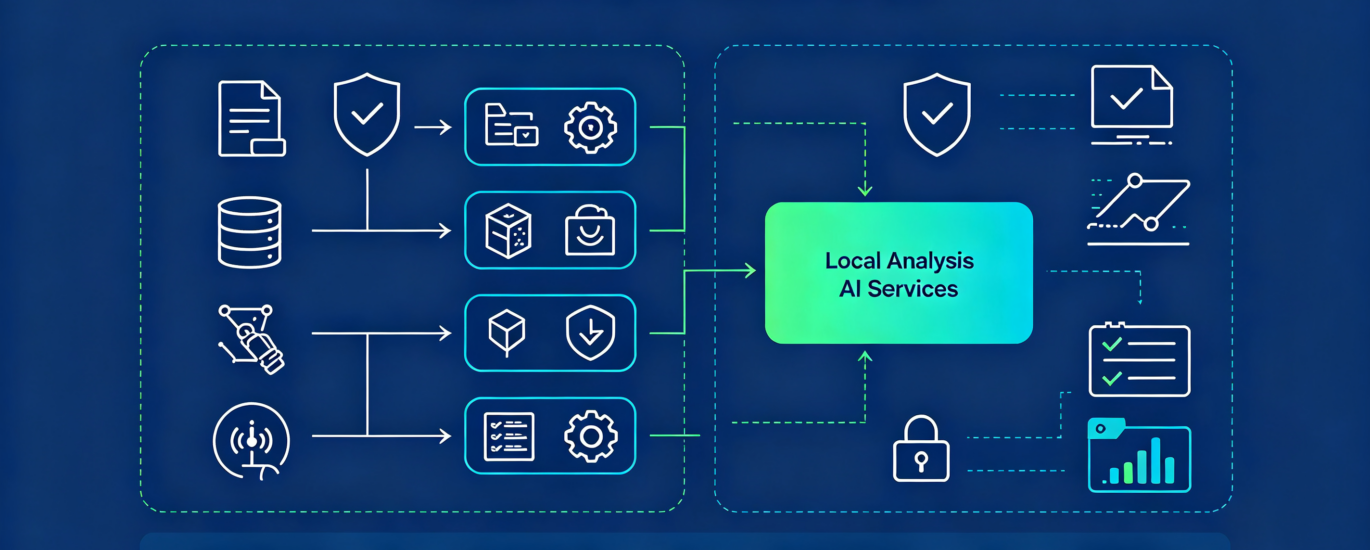
Effective governance is built on three interconnected pillars: Policy, Process, and Platform. This framework ensures principles are defined, executed consistently, and enforced by technology.
Pillar 1: Policy – The Rules of the Road
Establish clear, documented standards that everyone in the AI/data lifecycle must follow.
- Data Classification Schema: A simple taxonomy (e.g., Public, Internal, Confidential, Restricted) applied to all datasets, dictating how they can be used in AI. Example: “Restricted” data containing personal identifiers cannot be used for model fine-tuning without explicit, documented consent and PbD controls.
- AI Data Acceptable Use Policy: A specific extension of your general data policy that defines permissible sources (approved vendors, internal databases), prohibited uses (e.g., no facial recognition training without legal review), and requirements for data labeling and documentation.
Pillar 2: Process – The Operational Engine
Documented, repeatable processes turn policy into action.
- Data Provenance & Lineage Tracking: A mandatory process for logging a dataset’s origin, transformations, and use in specific model versions. Think of it as a nutrition label for your AI models.
- Pre-Fine-Tuning Data Assessment: A checklist-driven review before any dataset is used for training. It should cover rights verification, bias screening (using statistical tools), privacy review (PII detection), and quality checks for accuracy and completeness.
- Incident Response for Data Breaches: A specific protocol for potential AI data incidents, such as unintended PII leakage in model outputs or unauthorized access to a training dataset.
Pillar 3: Platform – The Technical Enforcer
Technology that automates and enforces governance at scale, integrated into your local AI stack.
- Unified Metadata & Catalog Layer: A central system (e.g., OpenMetadata, Amundsen) that acts as a “single source of truth” for all datasets, tracking their classification, lineage, and ownership.
- Automated Data Quality & Privacy Scanners: Tools that run automatically on data pipelines to detect PII, label quality issues, or flag potential bias indicators (e.g., skewed demographic distributions).
- Secure, Governed Data Workspaces: Dedicated, access-controlled environments (like isolated Docker containers or Proxmox VMs) where data scientists can work with approved datasets without the ability to make unauthorized copies or exports.
Implementing the Framework: A Technical Deep Dive
Here’s how to translate the pillars into concrete actions within your local AI architecture, leveraging and extending the infrastructure from previous articles in this series.
- Securing the Dataset Lifecycle: From Ingestion to Archive
Every dataset should flow through a governed pipeline.
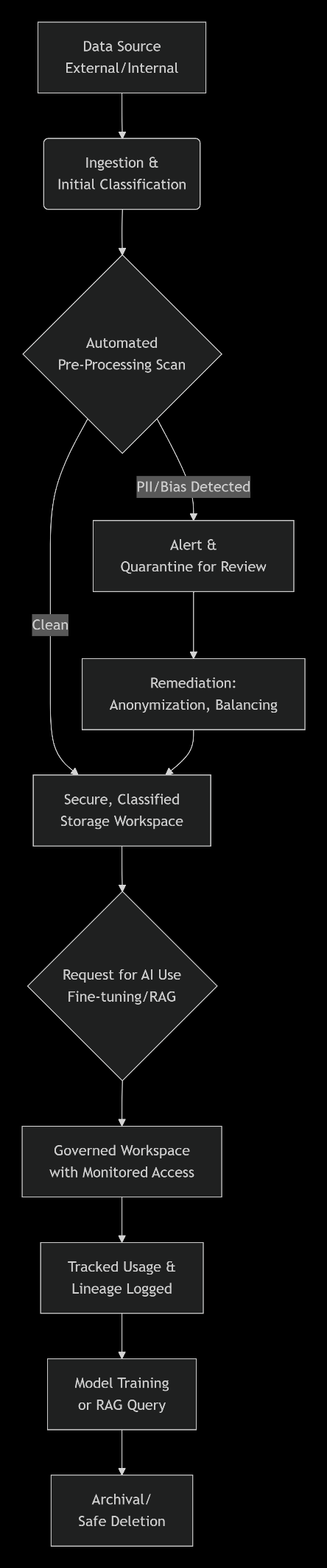
Key Tools & Commands:
- PII Detection at Ingestion: Use a tool like Microsoft Presidio or greyn directly in your data pipeline.
| # Example using a CLI scanner to check a dataset
python -m presidio_analyzer –text “Sample dataset content with email john@example.com” –all_fields |
- Lineage Tracking: Use the open-source OpenLineage standard with your data processing tools to automatically capture lineage events and push them to your metadata catalog.
- Privacy-Enhancing Technologies (PETs) for AI Workloads
Go beyond basic access control with techniques that protect data during use.
- Synthetic Data Generation: For testing or prototyping models, use tools like Synthetic Data Vault (SDV) to create realistic but artificial datasets that preserve statistical patterns without exposing real personal information.
- On-the-Fly Pseudonymization: Implement a service that dynamically replaces real identifiers (names, IDs) with tokens in documents before they are sent to the RAG retrieval or fine-tuning pipeline, reversing the process only for authorized users viewing final outputs.
- Building a Compliant Retrieval-Augmented Generation (RAG) Pipeline
RAG systems, which pull from internal document troves, pose unique governance challenges.
- Source Attribution: Your RAG system must be configured to log the exact source document(s) used for every generated answer. This is critical for auditability and verifying accuracy.
- Access Control at Chunk-Level: Implement vector database permissions so that queries only retrieve document chunks the user is authorized to see, preventing data leakage across departments.
Your 2026 Data Governance Readiness Checklist
Use this actionable checklist to assess and build your capabilities.
| Governance Area | Key Question for Self-Assessment | Action Step for Compliance |
| Provenance & Rights | Can we produce a legal basis for every dataset used in our AI training? | Create a Data Provenance Register (a simple spreadsheet or integrated catalog) documenting source, license, and lawful basis. |
| Privacy by Design | Is personal data in our AI datasets minimized and protected by default? | Implement automated PII scanning in all data preparation pipelines and establish a PET selection guide for projects. |
| Bias & Fairness | Do we have a method to detect potential bias in our training data? | Adopt a bias assessment toolkit (e.g., IBM AI Fairness 360, Google’s What-If Tool) and mandate its use in pre-training reviews. |
| Security & Access | Is access to AI datasets as controlled as access to our core financial systems? | Enforce role-based access control (RBAC) on all data storage and implement monitored, isolated workspaces for data science. |
| Transparency & Lineage | Can we trace which dataset version was used to create a specific model behavior? | Deploy a metadata catalog and require logging of dataset IDs in all model training and fine-tuning scripts. |
| Incident Response | Do we have a plan specific to an AI data breach (e.g., model memorizes PII)? | Draft and test an AI Data Incident Response Playbook that includes model retraining, notification procedures, and system audits. |
Conclusion: Data Governance as Your Competitive Moat
In 2026, robust data governance will cease to be just a compliance cost center. For organizations invested in local AI, it will become a core competitive differentiator and a strategic enabler. A well-governed data environment means your AI initiatives can move faster—safely. It allows you to leverage sensitive data for innovation without undue risk, to assure partners and customers of your ethical standards, and to build AI systems that are not only powerful but also fair, accountable, and trusted.
By implementing the framework outlined here, you extend the sovereign, secure foundation of your local AI infrastructure to the most vital component of all: the data itself. This transforms your local AI from a technically impressive setup into a mature, resilient, and truly valuable business asset, fully prepared for the regulatory and ethical landscape of the future.
Implementing enterprise-grade data governance for AI requires specialized expertise. LocalArch.ai helps organizations design and operationalize tailored data governance frameworks integrated directly into their local AI infrastructure. From PET selection to metadata catalog deployment, we ensure your data practices are as robust as your models. Contact us to build trust from the data up.